

Markets in a Minute - If Oil is Flowing, Why Are Prices Rising?
- Oil continues to flow through the Strait of Hormuz, but attacks on commercial ships have made each barrel more expensive to insure and transport.
- Higher energy costs are already visible in gasoline, fuel oil and airline fares, while many consumer-goods companies are absorbing costs through lower margins.
- Though higher oil prices are a headwind for inflation and growth, they are only one force shaping the economy. AI investment remains a tailwind, while the upcoming midterms could influence the policy response to elevated energy costs.
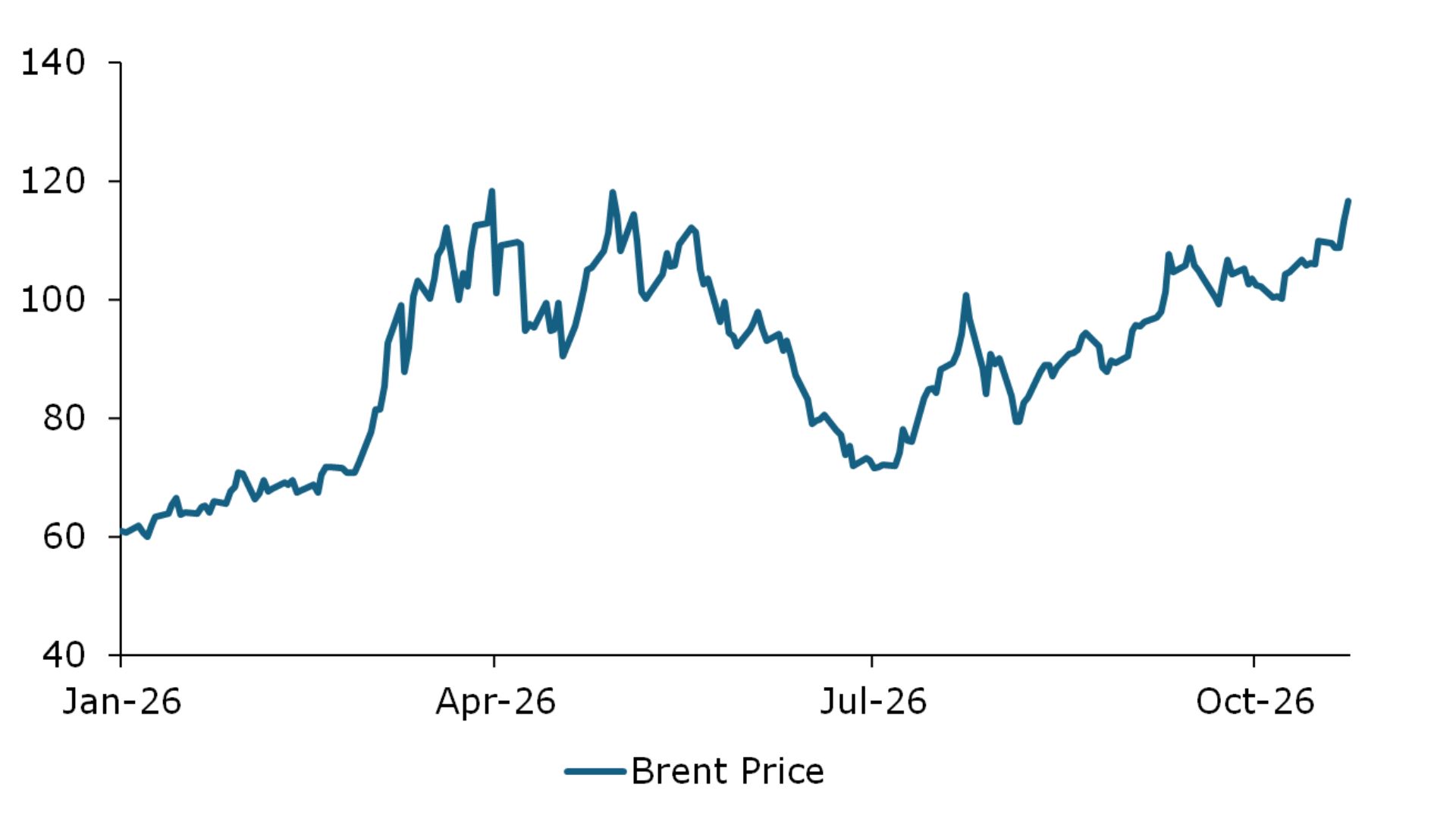
While oil is flowing through the Strait of Hormuz, Brent crude is trading above $110 per barrel. The apparent contradiction reflects an important feature of energy markets: the price of oil includes not only the cost of producing it, but also the cost of insuring, transporting, refining and delivering it.
Recent attacks on this critical energy route are raising the cost of doing business and creating three important consequences: greater pressure on consumers, a more complicated inflation outlook and a sharper policy debate ahead of the midterm elections.
Attacks Raise the Cost of Moving Oil
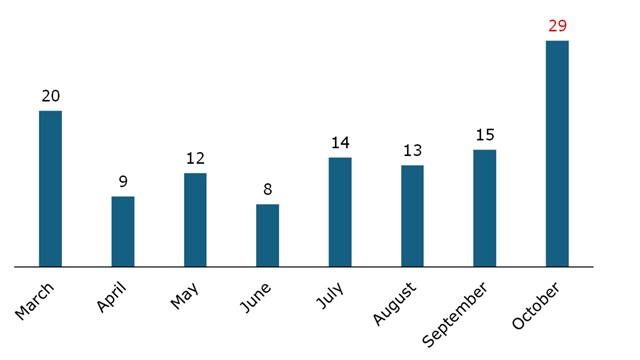
While the most recent conflict between the US and Iran began in March of this year, attacks on commercial ships traveling through the Strait of Hormuz have ramped up recently, aggravating already high oil prices. In the first three weeks of October, for example, there were 29 attacks on commercial ships, surpassing the previous monthly high of 22 in March. Because of those attacks, shipowners now take greater financial and operational risks with each voyage.
Commercial-Shipping Attacks Have Accelerated
Source: Kestra Investment Management with data from the International Maritime Organization and USNI News. Data through October 23, 2026.
Shipowners may charge more to enter the region, while insurers demand higher premiums to cover possible damage or delays. Longer or rerouted voyages also burn more fuel and keep vessels in transit longer, leaving fewer ships available for other deliveries.
The increase can be dramatic. For instance, last year, the oil supertanker Esteem Explorer cost an average of $9 million to carry roughly two million barrels of crude oil from the United States to Japan. It’s next journey in late November is expected to cost $81 million. That increase works out to $40.50 per barrel in shipping costs, approximately nine times the prior-year rate.
Rice University’s Baker Institute for Public Policy estimates that every $10-per-barrel increase in shipping costs adds approximately 23 cents per gallon to gasoline. Together, higher freight rates, insurance premiums and delivery risks add a geopolitical premium to crude prices.
In addition to the higher costs of transporting oil, it has also become more difficult and expensive to convert oil to products like gasoline and jet fuel. Because of the destruction or forced shutdown of refineries this year, roughly 10% of global refining capacity went offline, largely in Russia (2-2.7 million barrels per day) and the Middle East and Asia (7-8 million barrels per day).
Oil Adds to Inflation Pressure
Higher oil prices have driven broad inflation measures higher. Gasoline prices jumped 9.1% in September alone, accounting for more than half of the monthly increase in headline inflation. Compared with one year earlier, gasoline was up 34.2% and fuel oil was up 74.2%. Overall consumer prices increased by 3.7% from the previous year.
Middle East Tensions Have Driven Brent Crude Oil Prices Higher
Source: Kestra Investment Management with data from the U.S. Energy Information Administration and Bloomberg. Data as of October 26, 2026.
Gasoline and fuel oil represent the most direct effects, but crude oil begins a longer chain reaction that can show up on grocery store shelves, restaurant menus and travel. Airlines pay more for jet fuel, trucks pay more for diesel, and ships pay more for bunker fuel. Manufacturers also use petroleum-based products to make synthetic fibers, plastics and packaging.
This helps explain why airfare prices have increased so sharply and why apparel prices were up 3.4% from one year ago. However, the pass-through has been less visible in other categories. Food at home rose 1.8% over the year, while personal-care and household-cleaning prices increased more modestly.
Higher Costs Squeeze Consumers and Companies
Rising costs leave many companies with three difficult choices: raise prices and risk losing customers, adjust promotions or product sizes, or absorb the costs and accept lower margins.
Many companies are choosing to absorb the costs of higher transportation, packaging and material expenses instead of passing them fully to customers.
Procter & Gamble, which makes Tide detergent, Pantene shampoo and Pampers diapers, recently raised its estimate of the fiscal 2027 profit impact from higher commodity costs from $1 billion to approximately $1.4 billion. Its core operating margin declined 80 basis points during the latest quarter despite 250 basis points of productivity savings.
Other companies may preserve familiar price points by reducing package sizes, a practice known as shrinkflation. A 14-ounce package might shrink to 12-ounce while the shelf price remains unchanged. Companies with greater pricing power can pass costs along more directly. Airlines have raised fares as jet fuel costs surged. U.S. airfares climbed nearly 23% from a year earlier through September, although higher ticket prices have not fully offset the increase in fuel expenses.
Households ultimately feel the pressure through some combination of higher prices and less product for the same amount of money. Every additional dollar spent on gasoline, utilities or travel leaves less for other expenditures. Lower-income families generally feel the greatest pressure because necessities consume a larger share of their budgets.
What We’re Watching
Higher oil prices remain a meaningful headwind for consumers, inflation and economic growth. But the economy is rarely driven by one force alone. While higher energy costs are weighing on household budgets and corporate margins, investment in artificial intelligence and related infrastructure is supporting business spending and growth.
The upcoming midterm elections add another variable. Higher energy prices may influence both voters and the policy response, from domestic production to strategic reserves and foreign policy. For investors, the outlook will depend on how those forces balance: the drag from higher energy costs, the support from investment and innovation, and the policies that emerge after the election.
As always, invest wisely and live richly,
Kara
The opinions expressed in this commentary are those of the author and may not necessarily reflect those held by Kestra Advisor Services Holdings C, Inc., d/b/a Kestra Holdings, and its subsidiaries, including, but not limited to, Kestra Advisory Services, LLC, Kestra Investment Services, LLC, Kestra Private Wealth Services, and Bluespring Wealth Partners, LLC. The material is for informational purposes only. It represents an assessment of the market environment at a specific point in time and is not intended to be a forecast of future events, or a guarantee of future results. It is not guaranteed by any entity for accuracy, does not purport to be complete and is not intended to be used as a primary basis for investment decisions. It should also not be construed as advice meeting the particular investment needs of any investor. Neither the information presented nor any opinion expressed constitutes a solicitation for the purchase or sale of any security. This material was created to provide accurate and reliable information on the subjects covered but should not be regarded as a complete analysis of these subjects. It is not intended to provide specific legal, tax or other professional advice. The services of an appropriate professional should be sought regarding your individual situation. Kestra Advisor Services Holdings C, Inc., d/b/a Kestra Holdings, and its subsidiaries, including, but not limited to, Kestra Advisory Services, LLC, Kestra Investment Services, LLC, Kestra Private Wealth Services, and Bluespring Wealth Partners, LLC, do not offer tax or legal advice.