

Markets in a Minute - Worried About an AI Bubble? The Case for Emerging Markets
I talk to many investors around the country and the most common question I’ve been getting the last few months has been: are we in an artificial intelligence (AI) bubble? While we believe we are still in the early days of the AI buildout, the best way to cushion your portfolio from a potentially rocky road ahead is to own asset classes that behave differently from each other. One such differentiated asset class is emerging markets, potentially one of the most underrated storylines in the market this year.
So far in 2025, the MSCI Emerging Markets Index has returned more than 25%, nearly 10% higher than the S&P 500. This strength comes after over a decade of trailing the U.S. stock market. What’s driving this reversal in emerging market stocks and is it sustainable?
Emerging Markets vs. United States Year-To-Date Stock Market Performance (Jan 1 = 100)
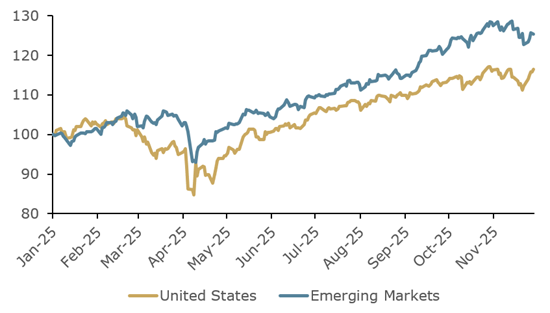
Past performance is not a reliable indicator of current or future results. Indexes are unmanaged and not subject to fees. It is not possible to invest directly in an index. United States returns are represented by the S&P 500 Index. Emerging market returns are reflected by the MSCI Emerging Markets Index. Source: Kestra Investment Management with data from FactSet. Performance data as of November 28th, 2025.
Should investors own emerging market stocks?
This year’s surge in the emerging markets index has been driven by countries as diverse and geographically distributed as South Korea, South Africa, and Mexico, which are all up over 40% year-to-date. Despite their diversity, these countries tend to share a handful of characteristics: faster-growing economies, a younger population and an expanding middle class. This greater growth potential can also come with greater risks, including more uneven growth rates, higher political volatility and less diverse economies.
Emerging markets, by their nature, can be hard to define. India, for instance, is one of the world’s largest economies whose influence is growing on the global stage. The country’s economy has features of a well-established developed market, including deepening capital markets, strong regulatory framework and highly sophisticated manufacturing. Conversely, persistent challenges in building a robust infrastructure and a low income per capita lag behind developed markets.
Emerging market stocks overall have benefited from attractive valuations relative to the U.S. market along with sustained weakness in the US dollar.
Next 12 Months P/E (Range, Current, 20 Year Long-Term Average)
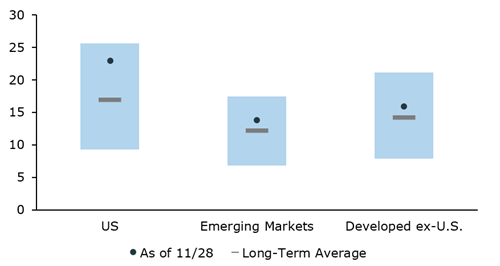
Past performance is not a reliable indicator of current or future results. Indexes are unmanaged and not subject to fees. It is not possible to invest directly in an index. United States returns are represented by the S&P 500 Index. Emerging market returns are reflected by the MSCI Emerging Markets Index. Developed ex-U.S. returns are reflected by the MSCI EAFE Index. Source: Kestra Investment Management with data from Bloomberg. Performance data from December 1st, 2005 to November 28th, 2025.
While 2025 has been a year to remember for the emerging markets, it’s worth mentioning that past performance doesn’t guarantee future results. As investors, it’s important to be prudent and forward-looking. So, can this shift in leadership sustain itself?
What Is the Outlook for Emerging Markets?
The U.S. economy and stock market have been resilient through a chaotic year, and Bloomberg’s forecast for earnings per share (EPS) growth in 2026 for the S&P 500 comes in at a healthy 13.0%. While that is a strong forecast outlook relative to developed market peers, it pales in comparison to the 17.3% expected earnings growth for the emerging market universe.
2026 YoY Earnings Per Share Growth Rates: U.S. vs. Emerging Markets vs. Developed ex-U.S.
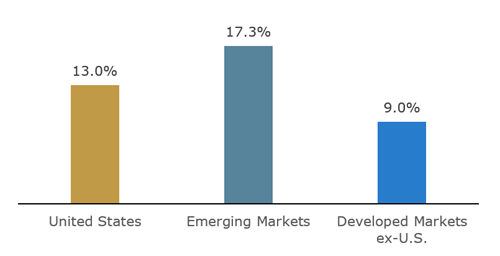
Past performance is not a reliable indicator of current or future results. Indexes are unmanaged and not subject to fees. It is not possible to invest directly in an index. United States returns are represented by the S&P 500, emerging markets returns are reflected by the MSCI Emerging Markets Index and developed ex-U.S. returns are reflected by the MSCI EAFE Index. Source: Kestra Investment Management with data from Bloomberg.
Because of the unique nature of emerging markets, adding stocks from those regions can help diversify portfolios. Diversification has become increasingly important at a time when the U.S. market is becoming concentrated into a select few leaders, particularly those tied to the artificial intelligence boom. By adding a prudent allocation across a range of geographies, investors can limit some of their dependence on an expensive U.S. market.
What Are the Risks of Emerging Markets?
While emerging markets offer stronger potential growth and lower valuations, they also come with risks. For one, emerging markets comprise a wide spectrum of countries that vary dramatically based on their policy, financial infrastructure and sector strengths. Performance in any single country can vary tremendously based on these and other factors.
In addition, geopolitical instability and de-globalization are becoming the new normal. Emerging markets generally suffer from more sensitivity to global shocks, and that can leave them more vulnerable during times of stress. In particular, President Trump’s tariffs can have an outsized impact on emerging market countries that are particularly reliant on exports to the United States.
The Case for Emerging Markets
Emerging markets can provide investors a combination of above-average economic growth, attractive valuations and access to new markets. In addition, the asset class can help opportunistic investors diversify away from US markets that are increasingly tied to AI.
Invest wisely and live richly,
Kara
The opinions expressed in this commentary are those of the author and may not necessarily reflect those held by Kestra Advisor Services Holdings C, Inc., d/b/a Kestra Holdings, and its subsidiaries, including, but not limited to, Kestra Advisory Services, LLC, Kestra Investment Services, LLC, Kestra Private Wealth Services, and Bluespring Wealth Partners, LLC. The material is for informational purposes only. It represents an assessment of the market environment at a specific point in time and is not intended to be a forecast of future events, or a guarantee of future results. It is not guaranteed by any entity for accuracy, does not purport to be complete and is not intended to be used as a primary basis for investment decisions. It should also not be construed as advice meeting the particular investment needs of any investor. Neither the information presented nor any opinion expressed constitutes a solicitation for the purchase or sale of any security. This material was created to provide accurate and reliable information on the subjects covered but should not be regarded as a complete analysis of these subjects. It is not intended to provide specific legal, tax or other professional advice. The services of an appropriate professional should be sought regarding your individual situation. Kestra Advisor Services Holdings C, Inc., d/b/a Kestra Holdings, and its subsidiaries, including, but not limited to, Kestra Advisory Services, LLC, Kestra Investment Services, LLC, Kestra Private Wealth Services, and Bluespring Wealth Partners, LLC, do not offer tax or legal advice.